Category: artwork

  • fill

    October 31, 2023
    Fill wins first prize at Eden Unearthed 2023
    November 2023- April 2024
    Curated by Meredith Kirton
    Eden Gardens, Macquarie Park, NSW

    Melissa is delighted to announce that her artwork, Fill, has been selected as the first prize winner at the 2023/24 edition of Eden Unearthed at Eden Gardens (IG: #edenunearthed @eden_macquariepark)!! It was a lovely surprise for Fill to be selected from a field of 35 diverse, evocative, beautiful, and often playful artworks by established and emerging artists. If you are in Sydney, please come by Eden Gardens to engage with their site-specific work, as well as to contribute to (re)making FILL. You can find my artist statement, the exhibition catalogue, and explanatory videos by all the artists at the Eden Unearthed website. And please follow Fill on Instagram at @fill_edenunearthed to see what happens over the next six months!
    fill
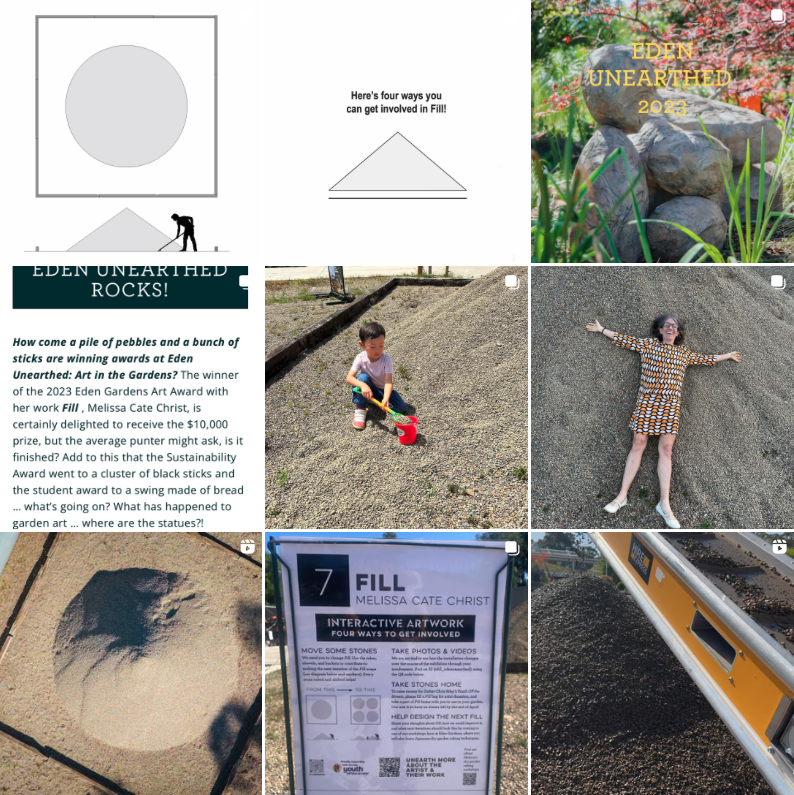
    Above: Some images from the project Instagram page; Below: Installation concept and ideas for getting involved!

    FILL
    v.tr. To put into (a container, e.g.) as much as can be held.
    n. An amount needed to make full, complete, or satisfied.

    Fill consists of a pile of gravel whose volume is equal to the capacity of the surrounding built edge. Drawing inspiration from Japanese dry garden (karesansui) practices, visitors are invited to collaboratively fill and shape a gravel garden through action such as shifting, raking, documenting, and (re)moving, making a place from what was once only a space. The intent of Fill is to engage visitors in a meditative process of destruction / construction – each visitor witnesses a unique moment in the history of the installation and contribute to its evolution through their participation.

    Here’s four ways you can get involved in Fill!
    1) Move some stones!
    Rakes, shovels, and buckets are available for you to contribute to making the next iteration of the Fill-scape – see the topo design plan and markers for where we are going – every stone raked and shifted helps.

    2) Take photos and videos!
    We are excited to see how the installation changes over the course of the exhibition through your involvement. You can post on IG (tag #fill_edenunearthed) or send to melissa@transverstudio.com.

    3) Take stones home!
    Our aim is to have no stones left by the end of April, and to raise money for Father Chris Riley’s Youth Off the Streets, so please fill a Fill bag for a $10 donation and take a part of Fill home with you to use in your garden.

    4) Co-design Fill 2.0 and 3.0!
    Share your thoughts about Fill, how we could improve it, and what the 2nd and 3rd iteration should look like by coming to one of our workshops (Dec 10 & Mar TBD – we will also learn Japanese dry garden raking techniques), or share to IG or melissa@transverstudio.com.

    August 10, 2023
    Fill selected to be part of 2023/24 Eden Unearthed exhibition
    Forthcoming November 2023- April 2024
    Curated by Meredith Kirton
    Eden Gardens, Macquarie Park, NSW

    Melissa’s interactive and collaborative installation Fill has been selected as one of over 30 artworks to be installed as part of the 2023/24 iteration of Eden Unearthed, a six month long exhibition located in the award winning Eden Gardens Display Gardens and in and amongst the Eden Garden retail centre and cafe. More details to follow! Please find more information on the call for submissions and on earlier editions of the exhibition here.

    fill
    eme3 festival
    selected participant
    2005

    fill
    Action = time. Through firsthand experience we construct out understanding of time, its passing marked by memorable moments of engagement in the world around us. FILL offers an opportunity for engagement, becoming an evolving marker of change. The installation consists of a pile of gravel centered within a built edge. The volume of the pile is equal to the capacity of the surrounding edge so that over time, the gravel will be distributed to fill the box. This distribution will be enacted though incidental forces, such as climbing or settling and also through intentional action, encouraged by the provision of a shovel on site. The changing form of the pile will be documented by a series of photographs spaced at equal intervals throughout the duration of the installation. FILL functions as evidence of action: both by engaging a succession of visitors in the process of construction / destruction; and by referencing the industrial history and continuing development of Poble Nou. Each visitor witnesses a unique moment in the history of the installation and contributes to its evolution. FILL is fully scalable, from an edge diameter of 8m to 48m and up. The locally sourced gravel will be reused at the end of the festival, in nearby construction sites if possible.
  • floating in Hong Kong

    March 29-30, 2014
    On Air: It all starts from the air
    Event organized by the Clean Air Network, art exhibition curated by Yan Kallen

    Melissa has been invited to exhibit photos from the ‘Floating in Hong Kong’ series at the event ‘On Air’ in Taipingshan. See the Facebook event page for more details.

    Artwork statement:
    Floating in Hong Kong
    Melissa Cate Christ / new.transversestudio.com/
    Project Team: Andrew Toland and 2012/13 HKU BALS2 students

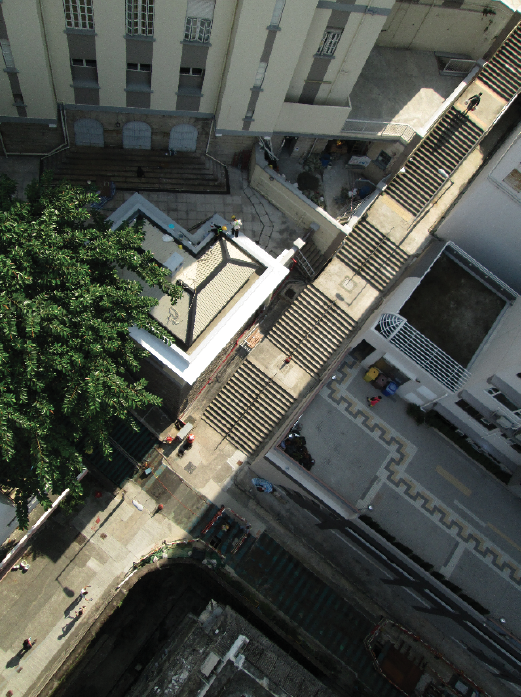
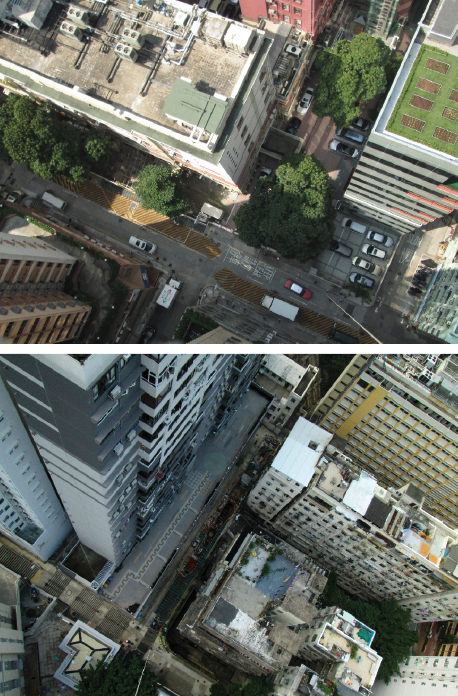
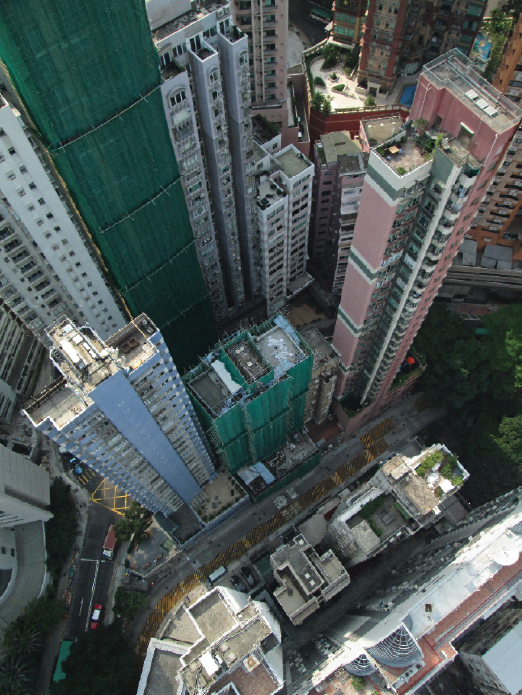
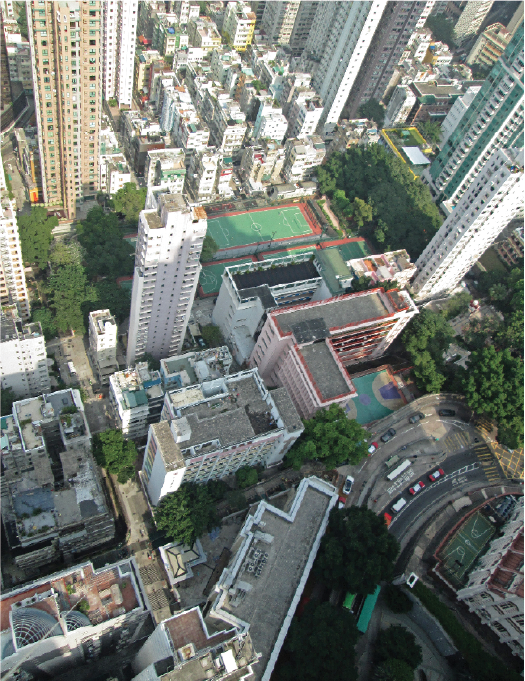
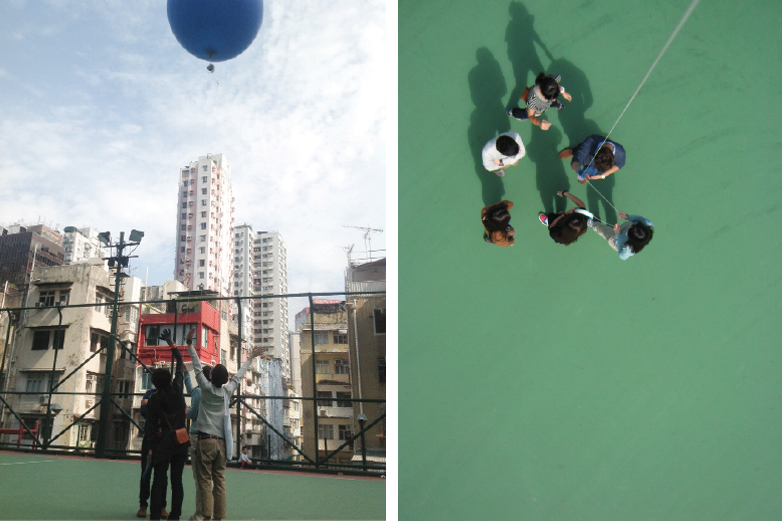
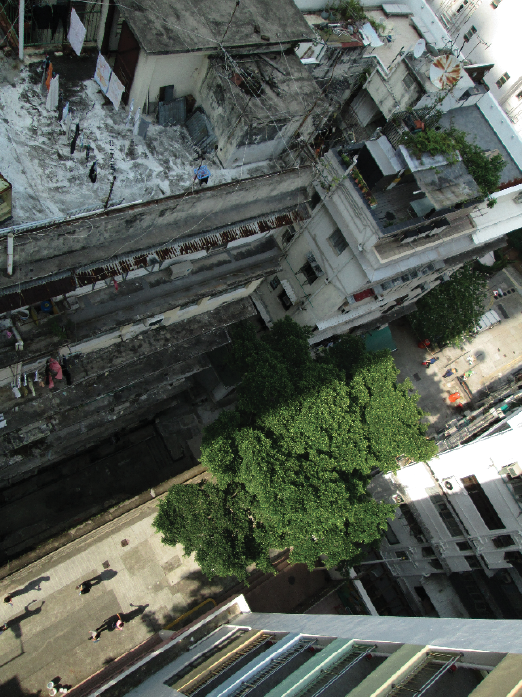
    This series presents a new way of seeing Taipingshan, familiar yet disorienting. Taken with a camera shooting continuously while attached to a weather balloon, the accidental and somewhat precarious perspectives flatten and convolute, but also reinforce, our typical understanding of Hong Kong’s densely layered urban environment. Simultaneously focusing on the neighborhood’s plentiful and often underused roofs and on the crevasses separating the towers, the images reveal the complex overlay of environmental, cultural and social conditions in Taipingshan. The lack of direct sunlight on a north-facing slope crammed tightly with high rise buildings, the visual and physical relief of trees and open spaces, people negotiating the city’s complex network of pedestrian pathways – the photos ask us to consider the duality of living both on the ground and in the air.
    Archiving a moment in a city perpetually reconstructing itself, our attention is captured by the spaces in between the buildings, the public spaces which are often overlooked by developers, but which make up our everyday lives, floating above, yet tethered to the ground.

    Excerpted from the organizers website:
    The Clean Air Network is hosting “ON AIR: It all starts from the air,” a two-day event which draws attention to air pollution, sustainable transport policies, and areas such as urban planning to explore how to make our cities more people-oriented. We invite the public to explore the neighborhood of Tai Ping Shan Street in Sheung Wan. In the public spaces, alleyways, parks, sport grounds and shops, there will be a variety of different happenings for the public to participate in. The hope is to rethink the relationship between air pollution, transportation policy, urban planning and our daily lives.

    Floating in Hong Kong
    Fall 2012 BALS2 Studio workshop
    Project Team: Andrew Toland and 2012/13 HKU BALS2 students

    Since moving to Hong Kong from Seattle two years ago to teach Landscape Architecture, I have often been frustrated when trying to use publically available aerial photos of this hyper-dense, hilly city in my practice and teaching. High-resolution aerials do exist, but are expensive to purchase. In those that I did acquire, much of the ground, stairs, alleys and streets in the study area of Sheung Wan on Hong Kong Island, is obscured or in shadow due to the height of the buildings and their location on a north-facing steep slope. Since aerials have always been a primary tool in my practice, it became increasingly apparent that I needed to find another way to document the present condition of the ground from the air. So after seeing a presentation by Liz Barry from the Public Laboratory for Open Technology & Science (PLOTS) about grassroots mapping, I decided to engage my students in a workshop to make our own low altitude aerials using a balloon and basic digital camera.

    floating in Hong Kong


    Imagining wrongly that the results of the workshop would allow us to stich together an accurate aerial picture of our studio site, the resulting photographs were surprisingly complex, uncovering a new way of working in and documenting Hong Kong. Piloted by the newly skilled hands of several BALS2 students, the photos document the strange juxtapositions between life on the ground and life up above, so familiar to many in this city of residential and commercial high rises. But their accidental angles, some bird’s eye views, some almost the view from a balcony or a roof terrace and some looking down precariously on even the taller buildings in the city, flatten and convolute but also reinforce our typical understanding of a densely layered urban environment. Simultaneously focusing on the buildings and on the spaces in between, the images captured by the rocking motion of the balloon question the typical modes of graphical projection we use in designing and representing our work and how they come to both define and limit our design proposals.
    What was intended as a basic aerial mapping exercise revealed instead a complex overlay of environmental conditions with cultural and social uses; the lack of direct sunlight on a north-facing slope crammed tightly with high rise buildings, the visual and physical relief of trees and open spaces, and people negotiating the city’s complex network of pedestrian pathways. Especially revealing was the coincidental overlay of multiple levels of living, integral to the lives of those who occupy the upper levels of buildings or are fortunate enough to have access to a terrace or roof. The perspectives captured by the balloon photos are almost familiar, but are disorienting enough to engender a reconsideration of the connections and spaces between the iconic and everyday buildings of Hong Kong, opening up a new way to guide future projects in this hyper-dense city.

  • dinner for 8 or to each their own

    dinner for eight or to each their own
    The Art of Urban Environments Festival, Easton, PA
    Finalist
    2011

    As a recovering post-industrial city with a rich history and a vibrant arts and cultural scene, Easton’s development of the Karl Steiner Arts Trail is an exciting step towards expanding and diversifying its pedestrian experience. A fertile ground for intervention, the trail’s adjacency and connection to sites of historical, cultural, and functional interest suggests possibilities for viewer discovery, interpretation, and engagement.

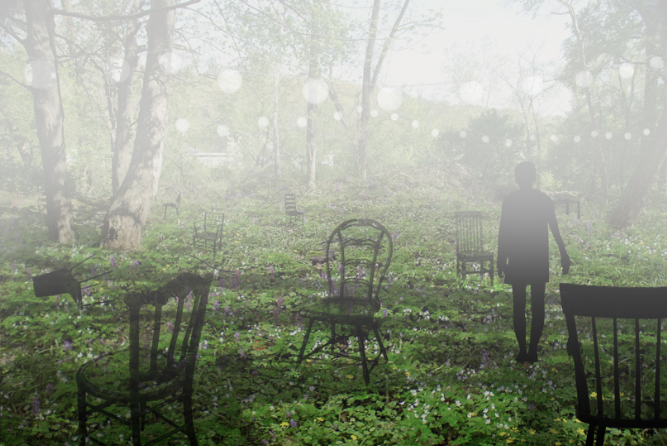
    Located along the trail at the Bend of the Bushkill, the forest clearing symbolizes both the wonder of nature and the agency of humans. Seen as a refuge from the wilderness or a flower filled sanctuary mysteriously untouched by human hands, the clearing is the historical gathering place of nymphs, pleasure parties, and solitary travelers. This conception of the clearing is set against the actual regenerative cycle of the forest – gaps are created and filled in an eternal process that can be slowed or stopped only by human intervention, often to perpetuate a memorable natural condition or to exploit the resources of the forest itself. It is this tension between the cycles of reality and memory, party and after-party, nature and culture, which forms the foundation for the proposed installation, dinner for eight or to each their own.

    Initial installation, Spring
    dinner for 8 or to each their own
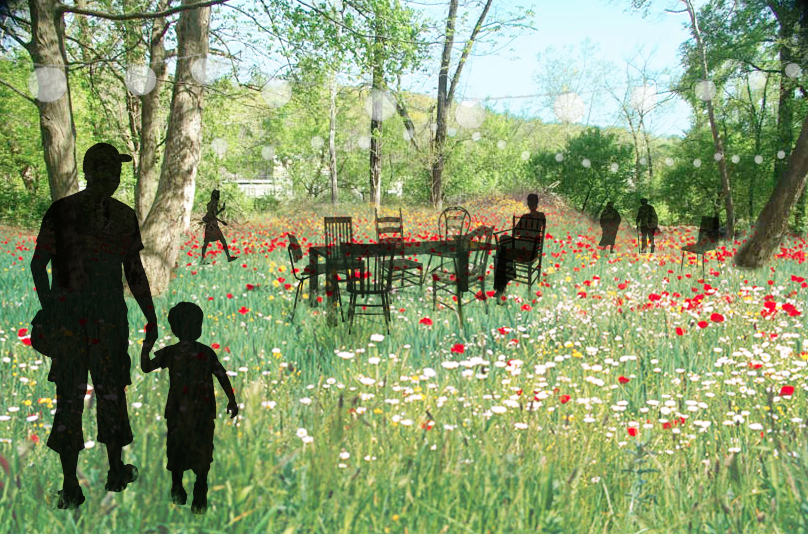
    Summer
    dinner for 8 or to each their own
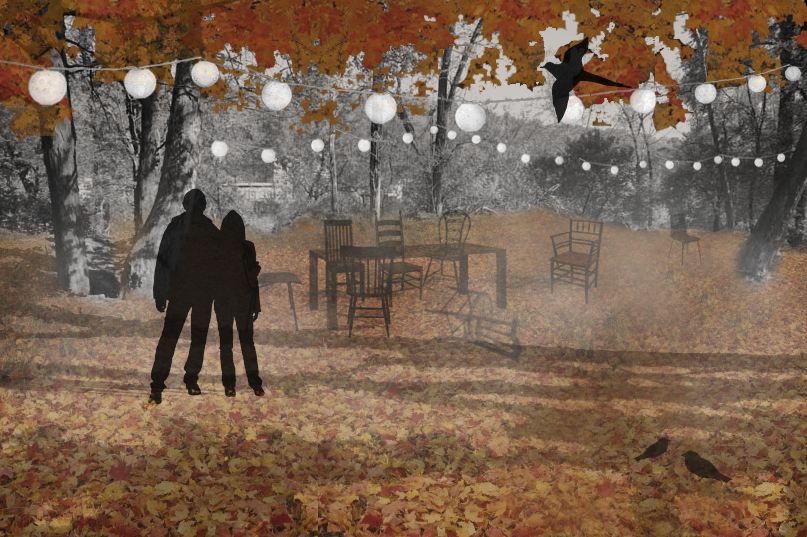
    Fall
    dinner for 8 or to each their own
    Separated from it’s historical adjacency to the Easton cemetery by U.S. Route 22, dinner for eight or to each their own explores the interaction of history, memory, and culture in the evolution of the natural environment, as well as the role of viewer discovery along the spectrum of hushed audience to active participant. Composed of a mismatched dining set collected from local consignment and antique stores to personify each period of Easton’s history, the installation begins in the spring as an abandoned site of a dinner party, presumably hastily vacated after a sumptuous feast and raucous crowd. Seeded with native successional groundcovers, grasses, and understory plants, the site will be progressively enveloped in vegetation as the seasons pass.

    Throughout the Festival, viewers are invited to be participants – to rearrange the furniture, to have their own picnic or dinner party, to simply be a part of the scene as they find it – therefore altering the trajectory of the installation and composing a new history for the objects, the planting, and the site itself. These transformations will be archived by the uploaded photo-documentation of visitors themselves – whether of neglected and weathered antiques that evoke the souls buried nearby or of an actively and regularly visited place. The installation is open ended, an evolving and changing experience which may or may not be visibly altered upon successive visits, but
    which will capture the imagination and inspire moments of inquiry, contemplation, and discovery.

  • memory stones

    Memory Stones
    Aids Memorial Grove International Design Competition
    Finalist
    2005

    The AIDS pandemic has reached global proportions: 20 million people have died of AIDS since 1981 and as of 2004, the number of people living with AIDS has reached 40 million. Four people contract the virus every minute, half of which are under the age of 25. For those whose lives have been directly or indirectly affected by this tragic disease, the National AIDS Memorial Grove is a sacred place for both gathering and individual reflection. As a living memorial, the dialogue between visitors and the ever changing landscape is integral to the process of healing; remembrance of those who have been lost and hope for those who continue to struggle and await a cure.

    memory stones
    The new memorial proposed for the grove is one which will develop over time, just as our understanding and hope must grow over time. The initial form of the memorial indicates both the immense proportions and the individual toll of this disease. To honor the different experiences of visitors to the grove, subsequent site specific installations will be built in collaboration between designers, artists, visitors and the community. memory stones
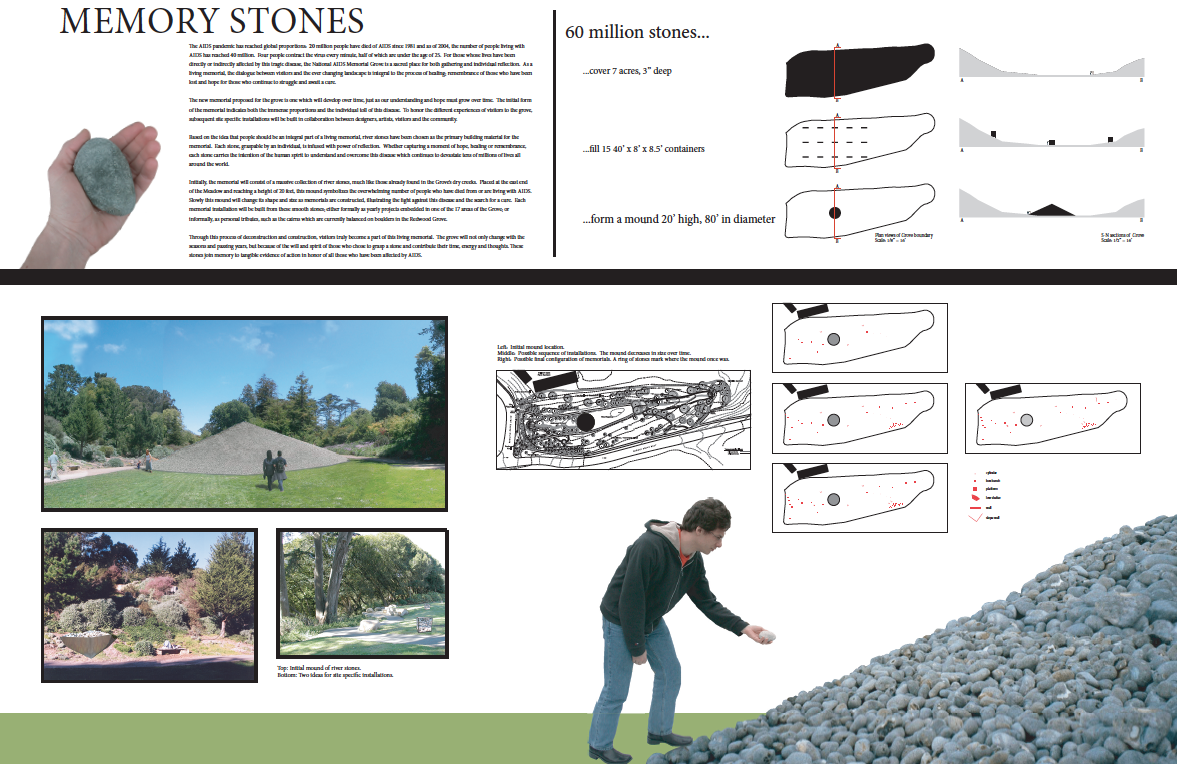
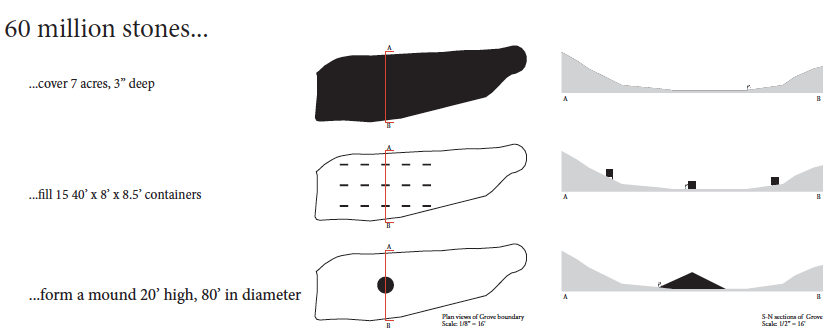
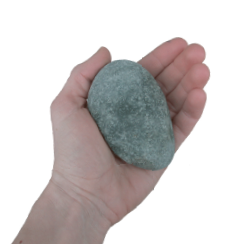
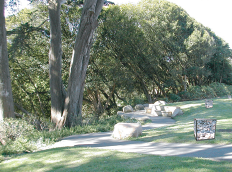
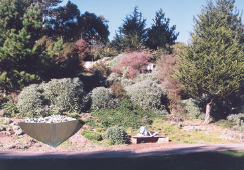
    memory stonesBased on the idea that people should be an integral part of a living memorial, river stones have been chosen as the primary building material for the memorial. Each stone, graspable by an individual, is infused with power of reflection. Whether capturing a moment of hope, healing or remembrance, each stone carries the intention of the human spirit to understand and overcome this disease which continues to devastate tens of millions of lives all around the world. Initially, the memorial will consist of a massive collection of river stones, much like those already found in the Grove’s dry creeks. Placed at the east end of the Meadow and reaching a height of 20 feet, this mound symbolizes the overwhelming number of people who have died or are living with AIDS. Slowly this mound will change its shape and size as memorials are constructed, illustrating the fight against this disease and the search for a cure. Each memorial installation will be built from these smooth stones; either formally as yearly projects embedded in one of the 17 areas of the Grove; or informally, as personal tributes, such as the cairns which are currently balanced on boulders in the Redwood Grove.
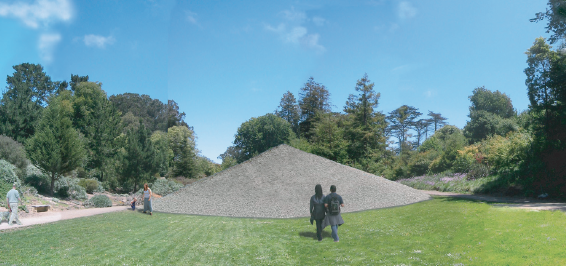
    Initial mound of river stones.
    memory stones
    Two ideas for site specific installations.
    memory stonesmemory stones

    Through this process of deconstruction and construction, visitors truly become a part of this living memorial. The grove will not only change with the seasons and passing years, but because of the will and spirit of those who chose to grasp a stone and contribute their time, energy and thoughts. These stones join memory to tangible evidence of action in honor of all those who have been affected by AIDS.

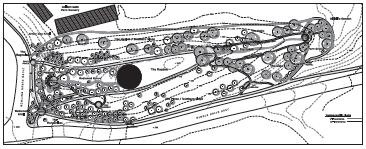
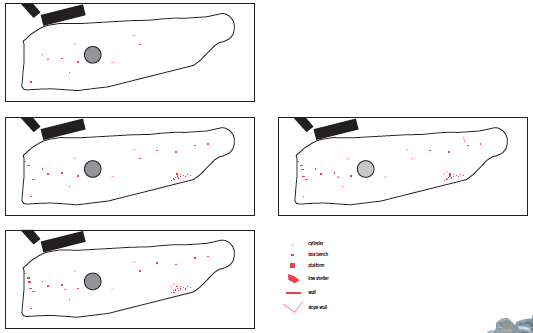
    Initial mound location, possible sequence of installations and possible final configuration of memorials. The mound decreases in size over time. A ring of stones mark where the mound once was.
    memory stonesmemory stones

    For more information on Aids memorials, the Grove and its history and the subsequent debate and discussion around the competition, see Jacob Cascio’s article and the 2011 documentary The Grove..