dinner for eight or to each their own
The Art of Urban Environments Festival, Easton, PA
Finalist
2011
As a recovering post-industrial city with a rich history and a vibrant arts and cultural scene, Easton’s development of the Karl Steiner Arts Trail is an exciting step towards expanding and diversifying its pedestrian experience. A fertile ground for intervention, the trail’s adjacency and connection to sites of historical, cultural, and functional interest suggests possibilities for viewer discovery, interpretation, and engagement.
Located along the trail at the Bend of the Bushkill, the forest clearing symbolizes both the wonder of nature and the agency of humans. Seen as a refuge from the wilderness or a flower filled sanctuary mysteriously untouched by human hands, the clearing is the historical gathering place of nymphs, pleasure parties, and solitary travelers. This conception of the clearing is set against the actual regenerative cycle of the forest – gaps are created and filled in an eternal process that can be slowed or stopped only by human intervention, often to perpetuate a memorable natural condition or to exploit the resources of the forest itself. It is this tension between the cycles of reality and memory, party and after-party, nature and culture, which forms the foundation for the proposed installation, dinner for eight or to each their own.
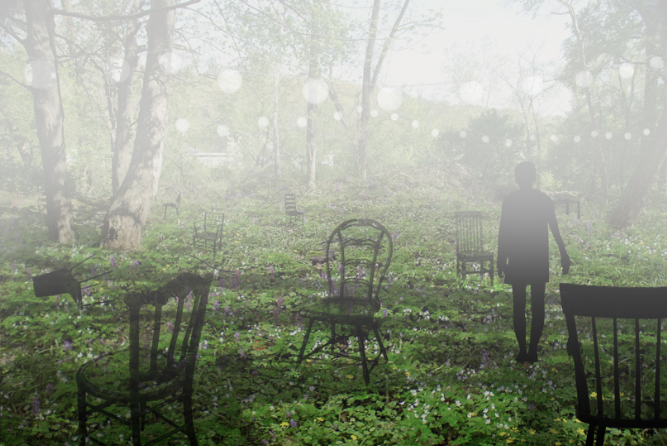
Initial installation, Spring
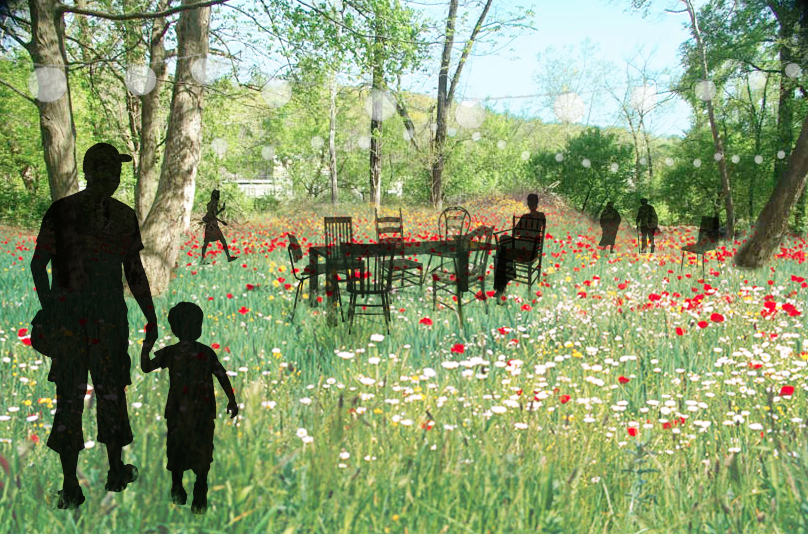
Summer
Fall
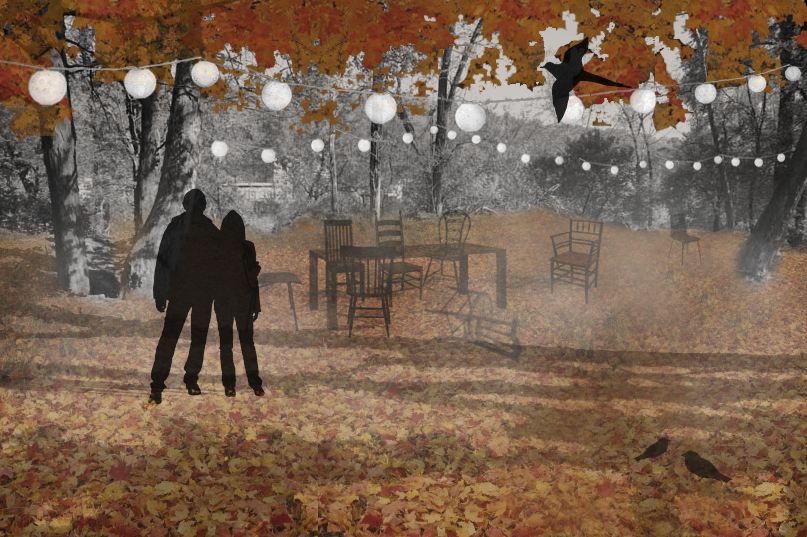
Separated from it’s historical adjacency to the Easton cemetery by U.S. Route 22, dinner for eight or to each their own explores the interaction of history, memory, and culture in the evolution of the natural environment, as well as the role of viewer discovery along the spectrum of hushed audience to active participant. Composed of a mismatched dining set collected from local consignment and antique stores to personify each period of Easton’s history, the installation begins in the spring as an abandoned site of a dinner party, presumably hastily vacated after a sumptuous feast and raucous crowd. Seeded with native successional groundcovers, grasses, and understory plants, the site will be progressively enveloped in vegetation as the seasons pass.
Throughout the Festival, viewers are invited to be participants – to rearrange the furniture, to have their own picnic or dinner party, to simply be a part of the scene as they find it – therefore altering the trajectory of the installation and composing a new history for the objects, the planting, and the site itself. These transformations will be archived by the uploaded photo-documentation of visitors themselves – whether of neglected and weathered antiques that evoke the souls buried nearby or of an actively and regularly visited place. The installation is open ended, an evolving and changing experience which may or may not be visibly altered upon successive visits, but
which will capture the imagination and inspire moments of inquiry, contemplation, and discovery.