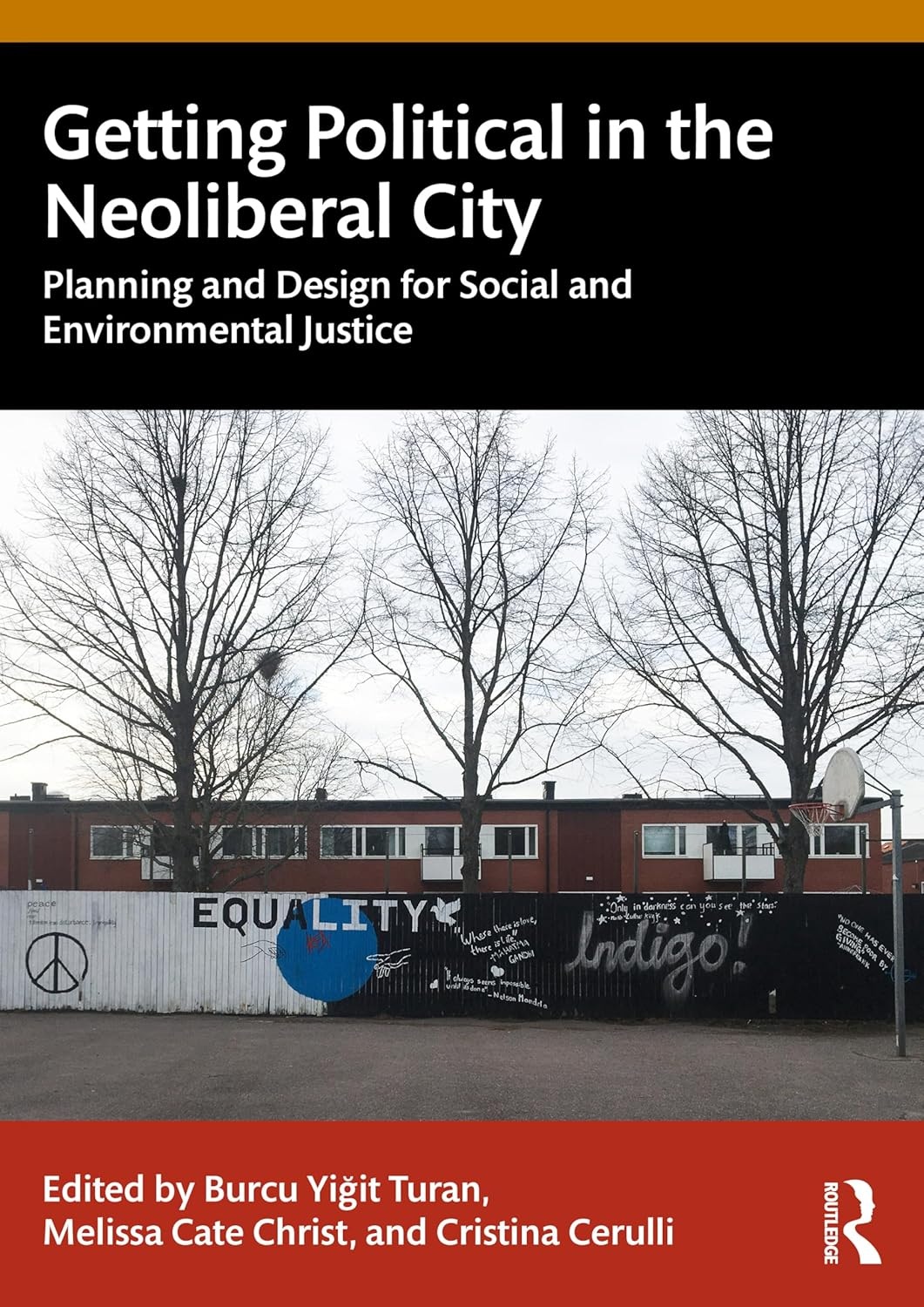
Getting Political in the Neoliberal City: Planning and Design for Social and Environmental Justice
Editors: Burcu Yigit Turan, Melissa Cate Christ and Cristina Cerulli
London: Routledge
We are very excited to announce the publication of our edited volume, ‘Getting Political in the Neoliberal City: Planning and Design for Social and Environmental Justice’!
Many thanks to my co-editors Cristina Cerulli and Burcu Yigit Turan, all of the chapter authors (Alexandra Crosby, Ilaria Vanni, Catherine De Almeida, Angela Gigliotti, Doris Gstach, Evelyn Kwok, Caio de Azevedo Barros, Gerônimo Leitão, Johan Pries, Claudia Seldin, Socrates Stratis and Almut Wolff), as well as the team at Routledge Taylor & Francis Group for making this book a reality!
Abstract:
In a world defined by ever-deepening crises—climate, social, economic, and political—urban spaces emerge as both battlegrounds of injustice and the arenas of possibility. Getting Political in the Neoliberal City interrogates the roles of planners, architects, designers, and urban citizens in challenging the pervasive inequities of neoliberal urbanism. Drawing from critical case studies spanning continents and disciplines, this volume reframes the intersections of spatial and social justice to illuminate how space becomes a site of power, exclusion, and potential resistance.
Through incisive essays and reflective scholarship, this book explores how cities are shaped by market forces and neoliberal governance, yet also serve as sites for insurgent practices at various scale, grassroots movements, and alternative imaginaries that resist dominant modes of urbanization and claim just ways of making cities. Highlighting the emergencess of new epistemologies, subjectivities and critical agencies, Getting Political in the Neoliberal City calls for a transformative rethinking of urban and environmental planning, design, and citizenship.
Featuring contributions from scholars and practitioners in diverse fields, including architecture, geography, political science, and anthropology, the book maps the tensions between depoliticized scholarly and professional practices and the urgent need for politicized action. With compelling examples from Australia, Brazil, Cyprus, Denmark, Germany, Hong Kong, the USA, and Sweden, this book offers fresh insights into ongoing research on the struggles for more equitable, inclusive, and environmentally just cities. It also provides opportunities to understand the historical contextuality of each case and to reflect on the nuances, similarities, and global connections between different cases across different geographies.
For more information on the book, and to purchase and read a copy, please head here.