inside-out garden / l’envers du jardin
seth denizen & melissa cate christ
Lausanne Jardins 2014_Landing Competition
Finalist
Lausanne Jardins 2014_Landing Exhibition
Old CFF Train Station, Lausanne, Switzerland
April 17 – 27, 2013
The soil in a garden has horizons, the layers that give the soil structure and fertility. These horizons are formed over time by processes of climate, organisms, geological history, and the slope of the ground. In the city, soil is also formed by urban processes, which produce new horizons. These horizons are extremely diverse, and are often mixed up in their spatial and chronological sequence in the ground. Soils found in urban areas are full of surprises, containing manufactured elements and geological artifacts intermixed in surprising and unknown ways. What we call urban soil is a largely unexplored material, especially in the context of supporting plants in a configuration of what we understand as a garden. To expose the complex juxtapositions that result in a surprisingly fertile ground, we propose a garden of earthly delights, in which the richness of urban soil is celebrated not just for its fertility, but also for its history as an archive of materials past and present. In this way, we propose to turn the garden inside-out, exposing the condition of the ground as both a medium and a material for the possibility and experience of the urban garden. 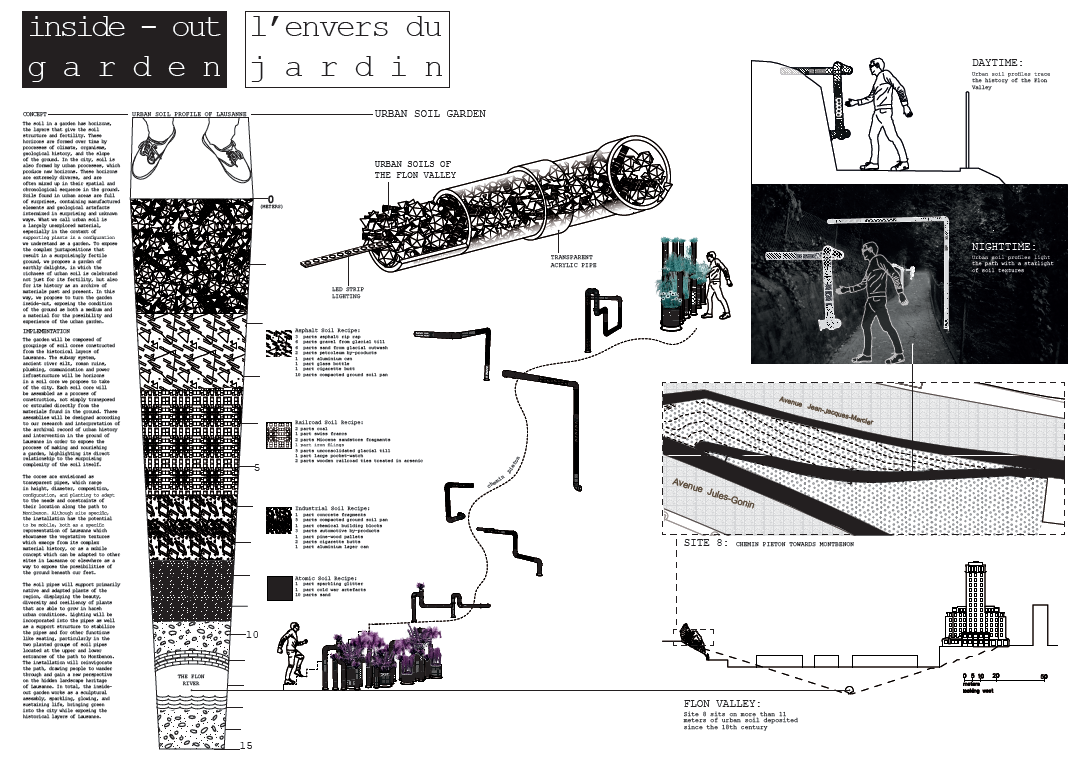
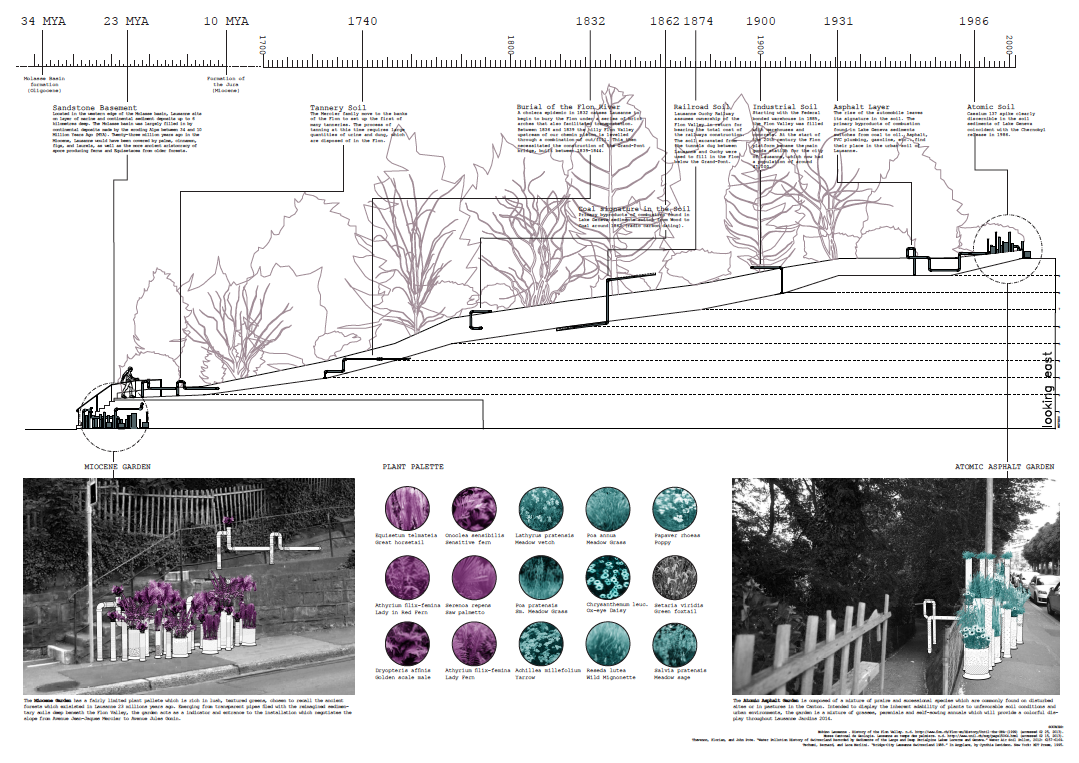 Drawing credit: Seth Denizen.
The garden will be composed of groupings of soil cores constructed from the historical layers of Lausanne. The subway system, ancient river silt, roman ruins, plumbing, communication and power infrastructure will be horizons in a soil core we propose to take off the city. Each soil core will be assembled as a process of construction, not simply transposed or extruded directly from the materials found in the ground. These assemblies will be designed according to our research and interpretation of the archival record of urban history and intervention in the ground of Lausanne in order to expose the process of making and nourishing a garden, highlighting its direct relationship to the surprising complexity of the soil itself.
The cores are envisioned as transparent pipes, which range in height, diameter, composition, configuration and planting to adapt to the needs and constraints of their location along the path to Montbenon. Although site specific, the installation has the potential to be mobile, both as a specific representation of Lausanne which showcases the vegetative textures which emerge from its complex material history, or as a mobile concept which can be adapted to other sites in Lausanne or elsewhere as a way to expose the possibilities of the ground beneath our feet. The soil pipes will support primarily native and adapted plants of the region, displaying the beauty, diversity and resiliency of plants that are able to grow in harsh urban conditions. Lighting will be incorporated into the pipes as well as a support structure to stabilize the pipes and for other functions like seating, particularly in the two planted groups of soil pipes located at the upper and lower entrances of the path to Montbenon. The installation will reinvigorate the path, drawing people to wander through and gain a new perspective on the hidden landscape heritage of Lausanne. In total, the inside-out garden works as a sculptural assembly, sparkling, glowing, and sustaining life, bringing green into the city while exposing the historical layers of Lausanne.